

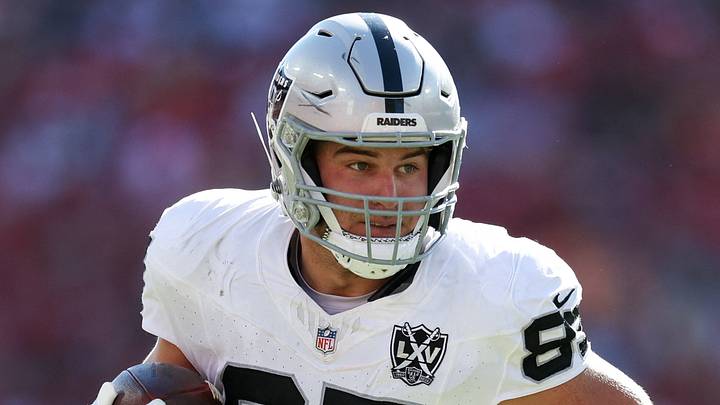
When it was reported that Michael Mayer was signing a three-year contract extension with the Las Vegas Raiders, a lot of fans were thrilled. Mayer is a talented player who hasn't quite had a fair shake, and the idea that he wouldn't hit free agency and finally had a long runway in Las Vegas was exciting.
But when the parameters of his deal were announced, a sense of worry crept in. Mayer, it seemed, would be making $15 million per year through the 2029 NFL season, which would be fourth-highest among NFL tight ends. That felt like a whole lot to pay for a still unproven player going into Year 4.
Typically, though, that big, flashy number that is initially reported is meant to make the contract look, well, big and flashy. Agents who negotiated the deal are now being acknowledged and tagged on social media, so it is harder to take these declarations at face value.
Because the finer details of Mayer's contract paint an entirely different picture of the pact that was signed. The truth of the matter makes the Raiders' perceived gamble look quite a bit less risky. And it was important, in many ways, for Las Vegas to structure the deal the way that they did.
Big number in Michael Mayer's contract extension with Raiders isn't what it seems
Note: all salary cap numbers are courtesy of Spotrac and Over the Cap.
The first thing that fans should look at in any contract is the amount of guaranteed money. For Mayer, that number is $30 million, not $45 million. The next step is to see how much is fully guaranteed, because even the "guaranteed" money isn't what it seems. For Mayer, that number is $22.5 million.
Contract structure and dead cap hits are also vitally important, as they can indicate just how tied the team is to the player financially. Deals can be front-loaded or back-loaded, and the larger a dead cap hit is for moving on from a player, the less likely a team is to ever cut bait with them. So, let's dive in.
A good part of Mayer's $45 million deal is a $9 million signing bonus that he was awarded right away. That doesn't count against the salary cap, but Mayer is still making $11.5 million this year, between the base salary from his rookie deal and the direct deposit from signing his extension.
That $9 million is part of his fully guaranteed money, as is the $2.5 million for 2026. Suddenly, we are already at $11.5 million of his $22.5 million that is fully guaranteed. And the other $11 million comes in next year, so Mayer really only has security through the end of the 2027 NFL season.
By then, he will have made all of his fully guaranteed money, and Las Vegas could cut ties with him for a small dead cap hit. If Mayer is released before the remaining guarantees on his deal ($7.5 million on the third day of the 2028 league year), the Raiders would only take on a dead cap hit of $4.6 million.
If they keep him for 2028, they owe him between $7.5 million and $14.2 million that year, but again, the team has the liberty to release Mayer ahead of 2029, with an "out" in his contract that would allow the Raiders to only take on a dead cap hit of under $2.3 million.
Take a look at this quick table, if you're more of a visual learner:
Year | Fully Guaranteed $ | Guaranteed $ | Dead Cap Hit if Cut |
|---|---|---|---|
2026 | 11.5 million | 11.5 million | 23.6 million |
2027 | 11.0 million | 11.0 million | 17.9 million |
2028 | 0 | 7.5 million (3rd Day) | 4.6 million |
2029 | 0 | 0 | 2.3 million |
Why it was important for Las Vegas to structure Michael Mayer's deal the way it did
Essentially, the Raiders, although keeping Mayer under contract, are making the fourth-year tight end prove it. If he hasn't taken significant steps toward being an elite, or at least a very, very good player who is worth that money, Las Vegas can come out of the deal after two years relatively unscathed.
But if Mayer is playing extremely well, then John Spytek and Tom Delaney (the Raiders' SVP and Director of Football Administration, a huge piece of the puzzle with football finances) got a great player at under market value, because the tight end market is about to explode in 2026 and 2027.
With little guaranteed money on the back end of the deal, if Mayer is performing exceptionally well, then of course, his camp will want to renegotiate. And at that point, if he has proven himself, that's fine. At least Las Vegas will know what it is paying for, unlike now, which is somewhat of a projection.
It should also not be lost on Raiders fans that Mayer's fully guaranteed money runs out in 2028, which is when the first year of Brock Bowers' inevitably market-shattering extension will kick in. So, if Mayer flops and Las Vegas needs to clear cap space, he would certainly be on the chopping block.
Now, Mayer could just play incredibly well and earn all $45 million of his extension this year and over the next three. But if he doesn't, the Raiders have safeguards in place, which make their apparent overpay look like a bet that has been hedged in a major way.
 Add us as a preferred source on Google