

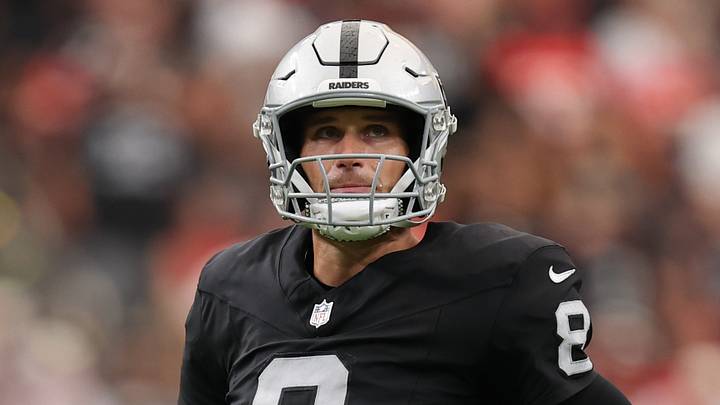
Las Vegas Raiders general manager John Spytek made out like a bandit when he dealt Kirk Cousins to the Minnesota Vikings for a third-round pick. It was masterful work by the still-new decision-maker, and yet he is getting close to no credit for it from a lot of this team's fans.
Luckily, recent history tells us that Las Vegas hit the jackpot.
Some in Raider Nation believe that, based on Minnesota's perceived desperation, Spytek and the front office should have held out for a higher pick. They think Las Vegas got bullied at the discussion table based on some reports, while other reports would tell you that the opposite happened.
Either way, the reality of the matter remains the same: the Silver and Black got a great return for an aging quarterback. If you don't believe that fact, then let us walk you through the quarterback trades that have occurred over the last 10 years, and that will surely change your perspective.
History says Raiders' Kirk Cousins trade was incredible work by John Spytek
Let's start with the basics: Since the 2016 NFL trade deadline, there have been 64 trades involving a quarterback. This does not include draft pick swaps that resulted in a team selecting a signal-caller, only deals that involved an active quarterback being sent to another team for players, picks, or both.
17 of those 64 netted a third-round pick or higher.
And while that already puts the Raiders in solid territory, it doesn't even begin to tell the story of just how favorable this deal truly was for Las Vegas. Let's continue with a narrower scope, and then we will widen it back out again.
Of those 17 quarterback trades that netted the trading team a third-round pick or higher, only two of them occurred in-season. Teams are far less likely to trade a starting QB in-season, as blockbuster deals typically come in the spring or the offseason, not during the grind of the fall campaign.
Those two trades?
Jimmy Garoppolo to the San Francisco 49ers - New England Patriots receive a 2nd-round pick
Kirk Cousins to the Minnesota Vikings - Las Vegas Raiders receive a 3rd-round pick
That's it.
Oh, and Jimmy Garoppolo was 25 years old. Cousins was 38.
The 15 other quarterback trades in the last 10 years that gave the trading team a third-round pick or more were completed in the offseason, at the draft or in the preseason. So, for the time of year that the Raiders were dealing, they accomplished something only one other team has in the last decade.
One could argue that Las Vegas should have held on to Cousins until the offseason because, if what I'm saying is the case, it could have gotten even more for him in a potential trade. But let's be honest: Fernando Mendoza was going to play at some point. Cousins was getting worse, not better.
Cousins' value was as high as it was going to be at this year's deadline, and with his $10 million guaranteed roster bonus looming next spring, it would have been tougher to deal him so close to that, especially after probably getting benched. The Raiders would have had zero leverage.
They didn't really have leverage anyway, and yet Spytek was able to pry a Day 2 pick out of Minnesota at the deadline.
But just to play Devil's advocate, let's go through those 15 trades and see why none of them are really comparable to Las Vegas' situation, and why holding on to Cousins until the spring would not have been fruitful, like some of these other deals.
In 2018, Alex Smith was traded to the Washington Redskins, and the Kansas City Chiefs received a third-round pick and a young cornerback by the name of Kendall Fuller. Fuller played two average seasons with the Chiefs before heading back to Washington in free agency.
First, this deal occurred in the offseason. Second of all, Smith was just 33, not 38. And third of all, this was similar to the Mendoza-Cousins situation because Kansas City had Patrick Mahomes waiting in the wings. But Smith was fresh off a Pro Bowl season, and Cousins got benched twice in two years.
Later that offseason, the Cleveland Browns sent a third-round pick to the Buffalo Bills for Tyrod Taylor. Keep in mind, though, that Taylor was 28 at the time, had a Pro Bowl campaign in 2015 (three years prior), and had three straight .500 seasons before getting dealt.
By contrast, Cousins' most recent Pro Bowl nod was five years prior to the deal, and again, he was a decade older and coming off three straight seasons in which he tore his Achilles and got benched twice consecutively. Yes, what he did with the Raiders matters, but the whole picture matters more.
Just before the 2018 season began, the New Orleans Saints sent a third-round pick to the New York Jets for Teddy Bridgewater and a sixth-round pick. Not only was Bridgewater just 25 years old at the time, but the Jets had to give up a Day 3 pick as well to get a third. Spytek didn't have to do that.
The following offseason, the Miami Dolphins sent the Arizona Cardinals a second- and a fifth-round pick for Josh Rosen. Rosen, who was 22 years old at the time, and was the No. 10 overall pick in the previous year's NFL Draft. Enough said.
After that, it was nearly two years until there was another significant quarterback trade. But one occurred in January of 2021 - a blockbuster between the Detroit Lions and the Los Angeles Rams that involved Jared Goff and Matthew Stafford.
Because Stafford was the commodity in this trade, let's talk about what the Lions received for him: Goff, who was 26, two first-round picks and a third-rounder. That is a mountain of capital. But it occurred in the offseason, Stafford was just 32, and he was considered one of the NFL's best QBs.
Cousins is not currently considered that. Nor was the deal in the offseason, nor is Cousins close to 32.
Weeks later, the Indianapolis Colts sent a first- and a third-round pick to the Philadelphia Eagles for Carson Wentz. Again, this occurred in the offseason, and Wentz was 28, which is a decade younger than Cousins is currently. A few years prior, Wentz was a Pro Bowler and led his team to a Super Bowl.
Months after that, to continue the quarterback frenzy, the Carolina Panthers sent the New York Jets a second-, a fourth- and a sixth-round pick for Sam Darnold. Darnold, who was only 23 years old and three years removed from being the No. 3 overall pick. The trade, again, happened in the spring.
2022 then had the week of blockbuster NFL quarterback trades.
33-year-old Russell Wilson, fresh off five straight Pro Bowl appearances, was acquired by the Denver Broncos, along with a fourth-round pick, for three solid players, two first-round picks, two second-round picks and a fifth-rounder. It's hard to compare that to the Cousins deal in so, so many ways.
That same day, Wentz was dealt again, as the Colts sent him to the Washington Commanders, along with a second- and a seventh-round pick, in return for a second-rounder and a pair of thirds. Wentz had just enjoyed a bounce-back season in Indy and was just 29. The deal happened in March.
Two days after that, the Houston Texans traded Deshaun Watson and a sixth-round pick to the Cleveland Browns for three firsts, a third-round pick, and two fourth-rounders. Watson was embroiled in controversy, yes, but also just 26 years old and already a three-time Pro Bowler.
We now arrive at the most comparable trade for Cousins, in a sense. Days after the aforementioned three deals went down, Indianapolis sent a third-round pick to the Atlanta Falcons for 36-year-old Matt Ryan, whose best days were clearly behind him.
Now, Ryan was still among the NFL's leaders in several passing categories in two of the three seasons leading up to this, and it was an offseason deal that involved a player two years younger than Cousins is. But even though these are close, it's not like the Colts did anything, or the Falcons missed him.
If you take nothing else from this article, remember that the Falcons benefited more from trading away 36-year-old Matt Ryan for a third-round pick than the acquiring Colts did.
At the next year's draft, 39-year-old Aaron Rodgers was traded to the Jets for a first-round pick swap and a fifth-rounder, while the Green Bay Packers netted two second-round picks and a sixth-rounder. Not to beat the drum, but this trade happened in the offseason. And it was Aaron Rodgers.
Rodgers was 39, yes, but he was a Pro Bowler in four of the last five seasons and the league's MVP in two of the three years leading up to the deal. While the ages are similar, and Rodgers was actually older then than Cousins is now, these two aren't on the same plane.
And once again, the Packers fared much better handing things off to their young quarterback, Jordan Love.
In 2024, the Seahawks acquired Sam Howell, along with a fourth- and a sixth-round pick, while giving up a third- and a fifth-rounder to the Commanders. While they technically got a third-rounder in the deal, it was effectively just two pick swaps, and Howell was only 23 years old. In the offseason!
The next day, Kenny Pickett was traded to the Eagles, along with a fourth-rounder, which gave the Pittsburgh Steelers a third-rounder and a pair of sevenths. Again, this is more of a pick swap than a pure third, and Pickett was 25 and still on his first-round rookie deal.
And last offseason, the Raiders sent a third-round pick to Seattle for Geno Smith. We all know how that ended: Las Vegas tanked, and the Seahawks went on to win the Super Bowl. But Geno was also just 34 and a Pro Bowler in two of the last three seasons.
Fans can relish in the fact that, in the Cousins deal, Spytek essentially got the third-round pick back that he sent away, at Pete Carroll's direction, to acquire Smith.
That leads us back to the Cousins trade. The 38-year-old, who was playing solid with the Raiders but was fresh off an Achilles tear, getting benched, and getting benched in his previous three seasons, netted Las Vegas a pure third-rounder.
All of the aforementioned trades either occurred in the offseason, included a much younger or more heralded player, or had some sort of pick swap attached to it. The Raiders got a third for a 38-year-old at the deadline whose recent résumé isn't exactly the strongest.
John Spytek - well done.
 Add us as a preferred source on Google