

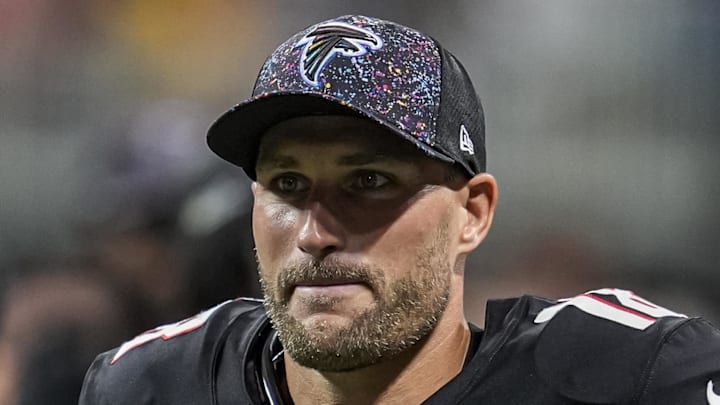
The Las Vegas Raiders signed Kirk Cousins on Thursday morning, ostensibly to be their starting quarterback. Of course, in reality, he'll serve, at the least, as the veteran mentor to presumed No. 1 pick Fernando Mendoza, and at the most, as the bridge for a few games until Mendoza is ready.
But the contract details for Cousins were going to be important for Raider Nation to see. Ideally, a team doesn't spend too much on what is effectively a placeholder, as that wouldn't be a very good team-building strategy by John Spytek and Klint Kubiak.
Just shortly after the deal was finalized, the details of the contract were released. And fans may have had a heart attack when reading the first line of Adam Schefter's tweet, where he reported that Las Vegas was signing Cousins to a five-year, $172 million deal.
Schefter did clarify that, in reality, this is a one-year, fully-guaranteed $20 million deal for the Raiders. But even that doesn't paint the full picture. Let's dive into what this contract actually means for both Cousins and the Silver and Black.
Las Vegas Raiders' Kirk Cousins deal isn't as bad as the big numbers make it look
Really quickly, though, as a sidebar, I'd like to nominate Cousins' agent for the Hall of Fame. This is the 11th-straight year that Cousins has had a guaranteed contract, which is unheard of in the NFL, especially for a veteran quarterback with exactly one playoff win. But I digress.
In reality, this Cousins deal, for the Raiders, is a one-year contract where Cousins will make $11.3 million in cash. The "$20 million guaranteed" is a bit of a misnomer, as the Atlanta Falcons, his previous team, are paying $8.7 million of that, and Las Vegas is chipping in just $1.3 million this year.
Now, you're probably wondering where the extra $10 million guaranteed is coming in. Well, the Raiders are giving Cousins a $10 million roster bonus that kicks in on the third day of the 2027 league year, and there is no offset language, meaning Las Vegas owes him that cash, even if he's cut.
Spytek and the front office could always wiggle their way out of this; however, if they can find a trade partner for Cousins before that date, or if they agree to push that date back a bit to do so. They were able to trade Geno Smith earlier this offseason, so I suppose anything is possible.
And Cousins, at $10 million, depending on how he plays in 2026, may be rather appealing to teams next offseason. But, as NFL Network's Tom Pelissero noted, it is more likely that Cousins ends up in the same spot a year from now, as a free agent with some guaranteed money in his pocket.
Okay, now you are probably wondering where that absurd $172 million number came from earlier. As part of this deal, the Raiders could pick up a two-year, $80 million option for Cousins, making this a potential three-year, $81.3 million deal. That extra $90.7 million over two years is just cap gymnastics.
Pulling a page from Philadelphia Eagles general manager Howie Roseman's playbook, as Spytek is prone to do, Las Vegas put void years into the contract so that they can spread out the salary cap hit over multiple years, should they pick up the option and then cut him or part ways for any reason.
So, in summary (and this is really all Raider Nation needs to know): Las Vegas is paying Cousins $1.3 million to play quarterback this year, and another $10 million in cash next year if they can't find a trade partner for him before the third day of the league year. They won't pick up that $80 million option.
Not a major investment, and not an indication that Cousins is the starter. The Raiders can stomach $11.3 million for a backup quarterback; they've spent their money on far-worse things over the years. Ideally, Cousins does his job, and both sides feel good about parting ways this time next year.
 Add us as a preferred source on Google