

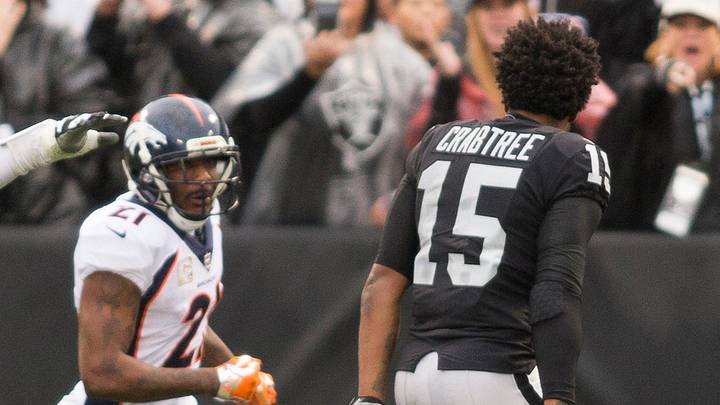
It cannot be overstated just how much the Las Vegas Raiders and Denver Broncos dislike eachother.
These two AFC West foes have been battling for years on end, and a bitter rivalry has been born. In a matchup like this, the records can be thrown out the window because the Raiders and Broncos will both bring their 'A' games when they see the other on the opposing sideline.
As Klint Kubiak takes his team into Mile High Stadium for the first time decked out in Silver and Black, Las Vegas will be in for an all-out war. But this article isn't about the upcoming matchup; this is about the rich history between two fierce adversaries. And the Raiders getting back in the win column.
Raiders lead Broncos 73-58-2 in all-time series
Sunday will mark the 134th meeting between these two proud franchises. And no matter the result, the good guys will leave with the all-time series lead, as it would take eight straight years of winning every game for the bad guys to take the lead. Let's take a look at how that difference was built.
The Raiders and Broncos first faced off in 1960.
That is before the Berlin Wall was constructed or the Cuban Missile Crisis began. Martin Luther King Jr. hadn't yet given his iconic "I Have a Dream" speech, nor had the Civil Rights Act been signed into law. These two teams have been playing football against each other since before JFK's inauguration.
In those 66 years as competitors, there has been a lot of back-and-forth. The series began with Denver taking down Oakland, but the Raiders responded months later with a 48-10 shellacking of the Broncos at Kezar Stadium. They won the next game, too, before the Broncos won three in a row.
Then, it was all Silver and Black.
Oakland won the first meeting between the two teams in 1963 and did not lose again until 1972. And then not again until 1974. And then 1977. Of course, there were two ties mixed in there, but the Raiders did not lose to the Broncos for 18 straight games and won 24 of 28 games, with two ties.
Dominance.
Denver found life in the late 1970s, winning four out of five matchups in 1977 and 1978, including an AFC Championship Game win over the defending champion Raiders in 1978. One of the most painful moments in the history of the Silver and Black, certainly.
The 1979 and 1980 seasons were all Raiders, then the Broncos won a series of low-scoring games in 1981. It was back-and-forth and exceptionally close over the following years, with the two teams even playing three straight overtime matchups in 1984 and 1985 and five in a span of 11 games.
By 1990, the Raiders had regained control of the series, winning 11 out of 12 games from 1989 to 1994. But once the team returned to Oakland, Denver had their number. And John Elway really found his stride with the Broncos.
From 1995 to 2000, the Broncos won 11 out of 12 games against the Raiders, and after the turn of the century, Denver won 11 out of 15. The all-time series was certainly beginning to get close. But the 2009 and 2010 Oakland teams swept Denver to keep them at bay before another Broncos run.
In a span of five years from 2011 to 2015, the Broncos did not lose to the Raiders. It was then split pretty evenly from 2015 to 2019, but once the Silver and Black moved cities, there was again a distinct change in the pattern.
As the Raiders moved to Las Vegas, Denver could not beat them. The Raiders won eight straight contests over the Broncos after they moved to Sin City, but in the last two years, Denver has swept Las Vegas. Which leads us to Sunday's matchup...
Signature moment: Oakland runs Denver out of its own stadium in 59-14 slaughtering, 2010
After scoring 9 points the week before against the San Francisco 49ers, Oakland came into Mile High Stadium on October 24, 2010, and put the Broncos through one of the worst losses in franchise history.
Oakland jumped out to a 38-0 lead in the first half before the Broncos even knew what hit them.
In what was undoubtedly the finest day of Darren McFadden's career, he notched nearly 200 all-purpose yards and four touchdowns against Denver.
Zach Miller got the scoring going with a 43-yard touchdown catch from Jason Campbell. Chris Johnson then had a pick-six of Broncos quarterback Kyle Orton, and then McFadden ran in and caught a touchdown. Along with a Sebastian Janikowski field goal, it was 31-0.
Just for fun, McFadden ran in another touchdown in the second quarter to put the spread at 38. The Broncos finally woke up, as Knowshon Moreno caught two touchdown passes to make it 38-14. But the Raiders decided to take it from there, scoring three more touchdowns to pile it on.
Marcel Reece found the end zone, as did Michael Bush, and McFadden put an exclamation mark on his day with a 57-yard touchdown jaunt.
Richard Seymour, Tommy Kelly, Kamerion Wimbley and Rolando McClain all recorded sacks.
And my dad made his friends, who were Broncos fans, stay until the bitter end.
Last time around: Pete Carroll opts for last-second field goal to salvage one-score loss for Raiders
Last season was a dark time for the Raiders. On the other side of this matchup, the Broncos became the team that finally dethroned the Chiefs and actually won the AFC West. And home-field advantage in the AFC playoffs. Anyway.
The Broncos traveled to Las Vegas late in the 2025 season to face lame-duck Pete Carroll and his team, who were 2-10. Denver was 10-2. This game was actually close at halftime, as the Raiders only trailed 14-7.
But Denver took control in the second half, getting out to a 24-7 lead and holding it until the final few minutes. Geno Smith finally mustered another touchdown drive to make it 24-14, and then the Broncos turned it over on downs with just over a minute left.
And when it became clear that the Raiders didn't have enough time to come back, as they were down 10 points with just a few seconds left in the game, Caroll inexplicably opted for a field goal, which Daniel Carlson made, to make it 24-17.
The field goal accomplished nothing other than making this a one-score game with no time remaining. It made the scoreboard look better to those who didn't watch. And that pretty much sums up the Carroll era.
Better times ahead.
 Add us as a preferred source on Google