

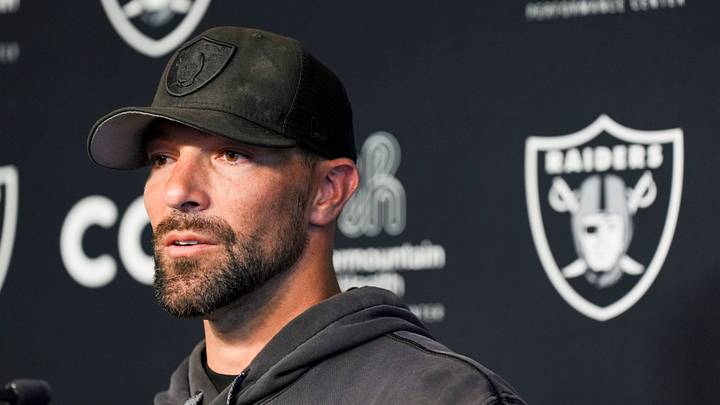
Following a three-game stretch to begin the season in which Rob Leonard looked like the next hot-shot head coaching candidate, the Las Vegas Raiders’ offense tumbled to unimaginable lows over the next six weeks. It seemed like things would never turn around.
But on Sunday against the Seattle Seahawks, despite losing 21-13, the Raiders’ defense actually took a small step forward. They managed to avoid a seven-game streak of allowing 30 points or more, they forced two turnovers and came up with a few stops in the fourth quarter to keep Las Vegas in it.
While this was undoubtedly progress for the Silver and Black on that side of the ball, stipulations must be mentioned. And I’m not ready to give Rob Leonard the credit for this improvement yet, as he still made several questionable decisions, resulting in a poor D+ grade for Week 10.
Raiders’ Rob Leonard earns D+ grade despite minor progress vs. Seahawks
After logging an F or D- in each of the last three games, a D+ is a sign of growth, by definition. But the Raiders were facing a Seattle offense missing its starting quarterback and its starting left tackle and left guard, both of whom are Pro Bowl-level talents. That’s a nice hand for Las Vegas to play.
And again, the defense fared fine, but there was no reason for them not to play exceptionally in this matchup. Not only did they get somewhat bailed out by Drew Lock coughing up the football twice, but there were a few key drops and penalties that negated hit plays for the Seahawks.
Not to mention, the game plan was poorly conceived.
Leonard should have sent blitzes far more often, considering he was facing a backup quarterback with several offensive linemen down. This is especially true because the Raiders’ defensive line and front seven cannot create pressure organically.
In addition to this shortcoming, he also set the unit up for some incredibly unfavorable matchups. Instead of learning from last week, when he left Quay Walker (but ultimately Tonka Hemingway) to cover Christian McCaffrey in the flat, he had Walker on Jaxon Smith-Njigba at one point.
The result of that play? A backbreaking, game-deciding 71-yard touchdown catch in which JSN slipped a few seconds after the ball was snapped. And don’t even get me started on the Raiders dropping Malcom Koonce into coverage, either.
Las Vegas still gave up 150 yards on the ground, failed to get pressure and got beat in coverage in part due to poor coverage design. The final result was better for the Raiders, but that doesn’t mean that the process necessarily was.
How Rob Leonard’s defense avoided an ‘F’ against Seattle
Results do matter.
Allowing 21 points and getting two takeaways prevents anyone from completely failing.
It took several great individual plays or performances to aid this unit’s success - not necessarily great scheming, - but the overall product was better. And Leonard did have a nice call or two, at least, and showed progress in several aspects.
This defensive backfield’s youth showed against Smith-Njigba, and that isn’t necessarily Leonard’s fault. But he could have helped them by finding a way to manufacture pressure or by altering the coverage on the back end. But he did not, so he still gets a D+.
Rob Leonard Report Card
Week 1 vs. Miami Dolphins: B (3.0)
Week 2 vs. Los Angeles Chargers: A- (3.7)
Week 3 vs. New Orleans Saints: B+ (3.3)
Week 4 vs. Kansas City Chiefs: C- (1.7)
Week 5 vs. New England Patriots: D- (0.7)
Week 6 vs. Buffalo Bills: C- (1.7)
Week 7 vs. Los Angeles Rams: D- (0.7)
Week 8 vs. New York Jets: F (0.0)
Week 9 vs. San Francisco 49ers: D- (0.7)
Week 10 vs. Seattle Seahawks: D+ (1.3)
GPA: 1.68
 Add us as a preferred source on Google