

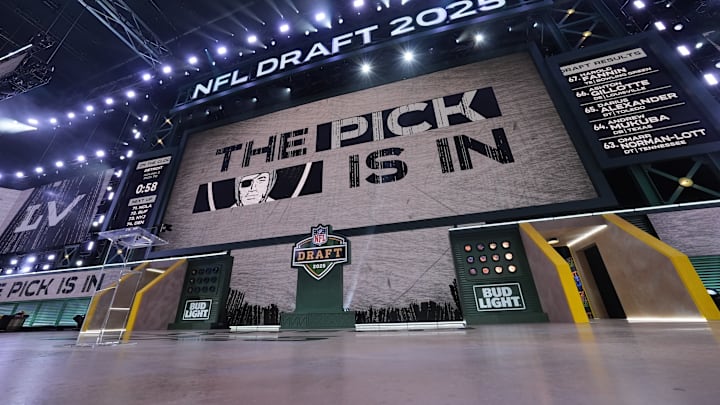
The Las Vegas Raiders will enter the 2026 NFL Draft cycle in a precarious position. They currently sit in the second overall spot on night one as Week 15 arrives, with a long list of organizational unknowns.
A difficult season has only heightened the scrutiny on the direction of the roster, the future of Pete Carroll, and the stability of the quarterback position. What is clear is that this franchise needs foundational talent at multiple positions and a clear plan for building a modern, sustainable core.
While much will change before we get to April, with scheme fit, personal evaluation, and conversations with scouts across football in mind, here is an early look at where the Raiders could go come April.
Raiders 2026 7-round NFL Mock Draft - December edition
Round 1 (No. 2 overall): Dante Moore, QB, Oregon
If Moore declares, he profiles as one of the most naturally gifted passers in the class and a legitimate candidate to be the first quarterback drafted. His size, power, and effortless arm talent give the Raiders a potential long-term centerpiece who can attack every blade of grass with confidence.
Moore’s upcoming exposure on the College Football Playoff stage should only elevate his trajectory, but the fundamental appeal remains the same: he is a poised operator with three-level accuracy, a willingness to challenge tight windows, and the physical makeup to stabilize a franchise in transition.
Round 2 (No. 34 overall): A'Mauri Washington, iDL, Oregon
The Raiders desperately need more mass, anchor, and disruption along the interior defensive line, and A'Mauri Washington offers exactly that profile. At 320-plus pounds, he plays with impressive explosiveness for his size and shows the three-down capability that modern defenses covet.
Washington’s game evokes some of the traits evaluators liked in Jamaree Caldwell coming out last year from the same program: low-pad power, immediate displacement in the run game, and the ability to reset the line of scrimmage. Adding him early on Day 2 gives Las Vegas a foundational piece to fortify its run defense and improve its overall physicality in the trenches.
Round 3 (No. 66 overall): Malachi Fields, WR, Notre Dame
Fields brings a big-frame element to the passing game that complements the Raiders’ evolving wideout room. At 6-foot-4 with legitimate explosiveness, he wins down the field with a blend of stride length, body control, and ability to play above the rim, as seen below:
Week after week Notre Dame WR Malachi Fields continues to pop on tape.
— Ryan Fowler (@_RyanFowler_) November 15, 2025
Hell of a play from the 6’4” UVA transfer. pic.twitter.com/2VCZIqMK8E
After transferring to Notre Dame from Virginia, his game has continued to ascend, and he offers the traits of a potential top-two option in an offense built around a young quarterback.
Round 4 (No. 102 overall): Genesis Smith, SAF, Arizona
Smith is a rangy safety whose versatility gives the Raiders another malleable piece to modernize their secondary. He offers strong run support downhill, enough athleticism to handle match assignments, and the frame to survive in traffic when asked to rotate late.
RELATED: Raiders could ditch Pete Carroll for this NFL Coach of the Year if he's fired
Round 4 (No. 127 overall): Xavier Chaplin, OT, Auburn
Chaplin is a massive, power-driven tackle prospect with a moldable skill set and a clear path to early rotational work. At 6-foot-7 with a heavy, forceful lower half, he excels in downhill run concepts and can displace defenders on a linear track. He profiles initially as a sixth offensive lineman with real developmental upside, particularly if he continues to refine his pass-set mechanics.
Round 4 (No. 135 overall): Harold Perkins Jr., LB/EDGE, LSU
An electric athlete, when healthy, Perkins Jr. is one of the most intriguing swing-tile prospects in the entire class. A former first-round caliber talent with explosive freshman-year tape, he has battled injuries and role uncertainty, but his ceiling remains extraordinary.
Perkins brings rare twitch, range, and edge flexibility and can align at multiple second and third-level spots. For a Raiders defense in search of playmaking juice, he offers the chance at a true value swing. If his development trajectory stabilizes, he has the tools to become one of the steals of the class.
Round 6 (No. 180 overall): Domani Jackson, CB, Alabama
Jackson arrives with a pedigree -- former five-star recruit, top-five corner in his high school class -- and meaningful experience at both USC and Alabama. His athletic traits remain appealing: he can run, he can play above the rim, and he has the physical profile to align inside or outside.
His next step is sharpening the technical aspects of man coverage and reducing reliance on zone principles. For Las Vegas, Jackson offers developmental upside, competitive toughness, and enough raw ability to justify a Day 3 investment.
Round 7 (No. 215 overall): Jack Pyburn, EDGE, LSU
Pyburn is the type of late-round pass rusher who can outperform his draft slot with the right deployment. His game is built on multidimensional pressure -- power through contact, functional bend, and a motor that carries him through the rep.
With SEC production (time spent at Florida and LSU) and the likelihood of a strong showing at the Senior Bowl, Pyburn presents a low-cost, high-effort rotational edge who can earn situational snaps early on. You can never have enough pass rushers...
 Add us as a preferred source on Google