

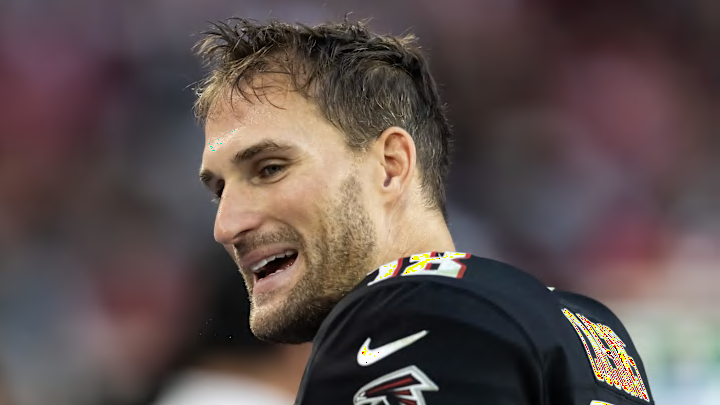
John Spytek has rightfully earned praise for the way that the Las Vegas Raiders have attacked the 2026 NFL offseason. But he couldn't have done it without the help of his fellow executives, pro scouting department, an ownership group willing to spend cash, or financial wizard Tom Delaney.
A lot more goes into building a great NFL roster than just talent identification and acquisition; the league has endless rules in place to ensure a level playing field. But the best in the business either find loopholes or unique ways to use those rules to their advantage. The Raiders are finally doing that.
When contract details were first reported after Las Vegas signed Kirk Cousins, it seemed like the team gave him a monster deal with too many stipulations to keep track of. But the way it will actually play out is quite simple: The Raiders will pay Kirk Cousins up to $11.3 million for one year of service.
Las Vegas pulled this off thanks to some serious cap gymnastics and outside-the-box thinking, which has seemingly struck a chord with some NFL reporters and made them question whether the league will continue to turn a blind eye to this stroke of genius from Spytek and the Raiders' front office.
Las Vegas Raiders seemingly found a loophole with their Kirk Cousins deal that reporters expect NFL to close
Pro Football Talk's Mike Florio, who is notoriously hard on the Silver and Black, especially since Tom Brady has become a minority owner, saw the way that Las Vegas approached and structured their deal with Cousins. He wrote an article calling out the Raiders for taking advantage of a loophole.
"As mentioned on Thursday, it seems too easy. Too convenient. Too obvious that the Raiders came up with a way to get Cousins to $20 million while paying only $11.3 million of it," Florio wrote. "Frankly, it’s amazing the loophole even exists. It’s something other teams could have been doing, whenever a player has guaranteed money from another team. Pay him the minimum now, and promise more later. Legitimate or not under current rules, it seems as if the Raiders have pulled a fast one."
Florio also backed a sentiment from Sports Illustrated's Albert Breer, where he insinuated that the NFL owners may want to change this rule the next time they're given the opportunity to vote on such a thing.
"I'll be interested to see if owners look to close the opening that Kirk Cousins and his people found here to get him the extra $10 million for 2027," Breer wrote. "Lots of teams have policies on including offsets. Cousins is basically circumventing that to double dip."
Breer noted that this didn't happen with Tua Tagovailoa and the Falcons, nor Kyler Murray and the Minnesota Vikings this offseason. Had those teams seen Las Vegas pull this off prior, Breer believes that they would have operated in a similar fashion.
This is mere speculation on my end, but it wouldn't surprise me if the timing of the Raiders' Cousins deal was such that it couldn't be discussed at the NFL Annual League Meeting earlier in the week, and they got it done after the other veteran quarterback dominoes had fallen.
Simply put, both Florio and Breer, and I'm sure a few others, are half in-awe and half skeptical or suspicious of how Las Vegas pulled this off. And if the NFL was ever going to change a rule, it'd be after the Raiders figured out how to skrt their way around it.
If you're still a bit confused about the complex nature of this deal, let's dive back what all these ridiculous numbers mean.
Cousins will effectively make $20 million to play for the Silver and Black in 2026. So, how is it that Las Vegas is only paying him the league's minimum salary for a veteran, and Cousins will only count as $1.3 million against the salary cap this upcoming year?
Well, because Cousins' contract with the Atlanta Falcons had a $10 million guarantee with offset language, meaning the Falcons had to cover any difference to get Cousins' 2026 salary to $10 million, whether he was on the team or not, if applicable.
So, Atlanta is paying $8.7 million because the Raiders aren't paying Cousins very much at all this year. But why would Cousins agree to this? Surely, he could have made more money on the open market by simply signing a less-complicated contract with another team.
He likely did so because Las Vegas has guaranteed $10 million to Cousins on the third day of the 2027 league year with no offset language, meaning the Raiders will fork out that cash a year from now, unless they find a trade partner for him. That will count against the 2027 cap for Spytek and Co.
And Cousins won't care about the 2027 cap situation in Las Vegas because he is almost certainly not going to be there. The Silver and Black effectively gamed the system so that both they and Cousins' camp were happy, and they left Atlanta footing the bill and the league wondering how it all happened.
 Add us as a preferred source on Google